Back to Catalog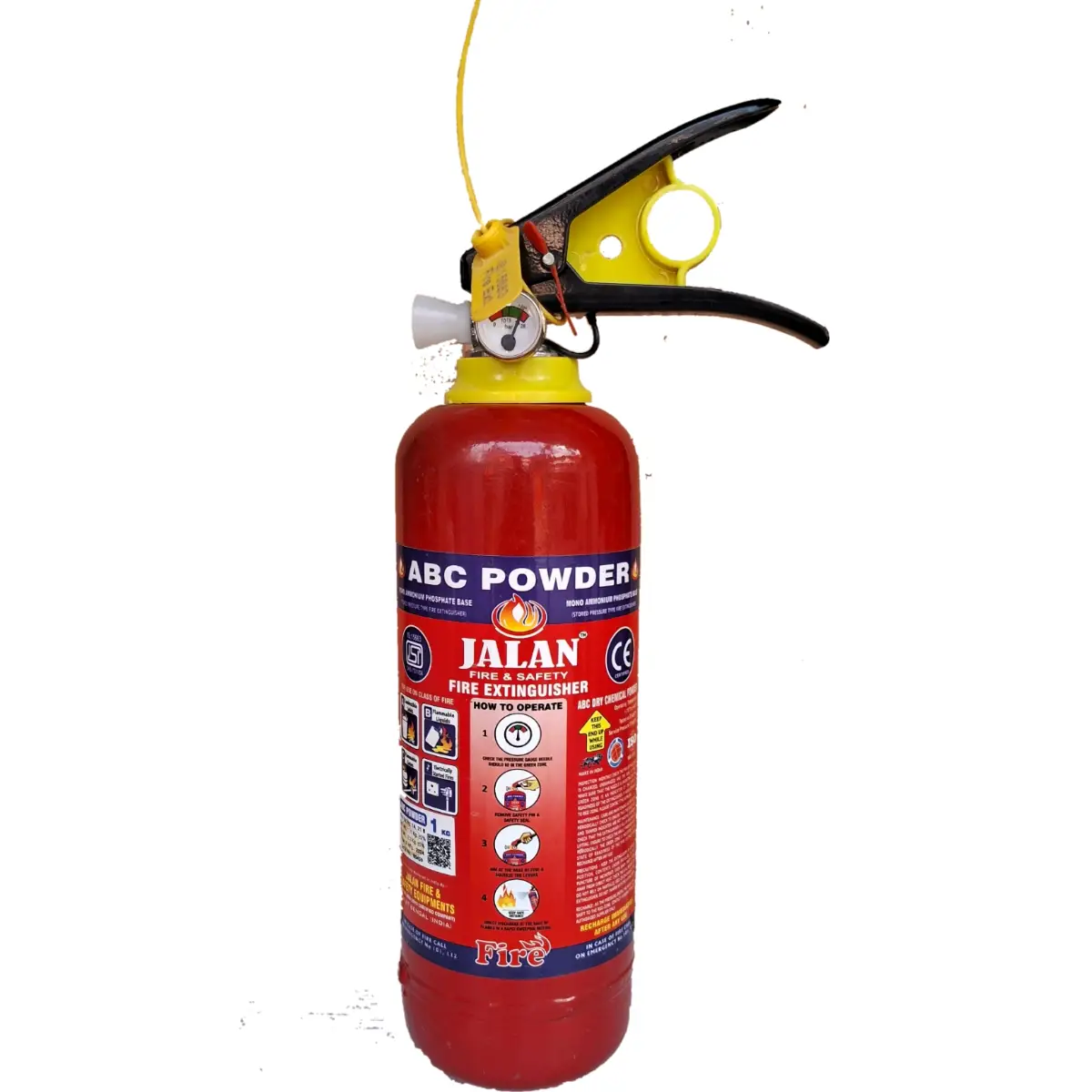
Technical Specifications
Product TypeABC Dry Chemical Powder (DCP) Fire Extinguisher, Capacity: 1 kg, Extinguishing Agent: Monoammonium Phosphate Dry Chemical Powder, Fire Rating: Suitable for Class A, B, and C fires, Propellant: Nitrogen Gas, Operating Pressure: 12–15 bar (typical), Discharge Time: Approximately 6–10 seconds, Operating Temperature: -20°C to +55°C, Body Material: Powder-Coated Mild Steel, Mounting: Wall or Vehicle Mounting Bracket, Applications: Homes, offices, vehicles, shops, and small commercial areas, Compliance: Manufactured in accordance with applicable fire safety standards, Features: Lightweight, portable, durable, and provides multi-purpose fire protection.
How to Operate / Use
1. Pull the safety pin to unlock the extinguisher.
2. Aim the nozzle at the base of the fire, not at the flames.
3. Squeeze the handle firmly to release the extinguishing powder.
4. Sweep the nozzle from side to side across the base of the fire until it is completely extinguished.
5. Maintain a safe distance while operating the extinguisher and move closer only if necessary.
6. Watch the area after extinguishing the fire to ensure it does not reignite.
7. Evacuate and call emergency services if the fire grows, spreads rapidly, or cannot be controlled safely.
Fire Extinguishers
ABC 1kg Fire Extinguishers
1500
Overview
An ABC 1 kg fire extinguisher is a compact dry chemical powder extinguisher designed to tackle Class A (wood, paper, cloth), Class B (flammable liquids), and Class C (flammable gases) fires. Its lightweight size makes it ideal for homes, offices, vehicles, and small commercial spaces, providing quick and versatile fire protection in emergencies.
Comprehensive Guide & Safety Insights
Fire safety is an essential component of protecting lives, property, and business operations. Among the various fire protection devices available today, the ABC 1 kg fire extinguisher is one of the most widely used and versatile portable firefighting tools. Designed to combat multiple types of fires, it serves as an effective first-response solution for homes, offices, vehicles, retail stores, educational institutions, and small commercial facilities. Its compact size, ease of operation, and ability to extinguish Class A, Class B, and Class C fires make it an indispensable part of any fire safety program.
The ABC 1 kg fire extinguisher contains a dry chemical powder, typically monoammonium phosphate, which acts by interrupting the chemical reaction that sustains combustion. Unlike specialized extinguishers that are suitable for only one type of fire, the ABC extinguisher provides protection against ordinary combustible materials such as wood, paper, cloth, and plastics (Class A); flammable liquids such as petrol, diesel, paint, and solvents (Class B); and flammable gases such as LPG, propane, and butane (Class C). This broad applicability makes it one of the most practical fire extinguishers for general-purpose use.
The typical construction of an ABC 1 kg extinguisher consists of a powder-coated mild steel cylinder filled with one kilogram of dry chemical powder and pressurized using nitrogen gas. The extinguisher is equipped with a valve assembly, discharge nozzle, pressure gauge, safety pin, and carrying handle. When activated, the nitrogen gas forces the extinguishing powder through the nozzle at high speed, allowing the user to direct the agent toward the base of the fire. The powder forms a protective layer over the burning material, separates oxygen from the fuel source, absorbs heat, and interrupts the combustion process, resulting in rapid fire suppression.
The effectiveness of a fire extinguisher depends not only on its design but also on proper installation and accessibility. An ABC 1 kg extinguisher should be mounted in a visible and easily accessible location where it can be quickly retrieved during an emergency. It should never be obstructed by furniture, equipment, or stored materials. In vehicles, the extinguisher should be securely mounted using an approved bracket to prevent movement during travel. The installation location should be protected from excessive moisture, corrosive environments, direct sunlight, and extreme temperatures that could affect the performance of the extinguisher.
Proper operation of the extinguisher is equally important. Users should follow the internationally recognized PASS method. The first step is to Pull the safety pin, which unlocks the operating mechanism. The second step is to aim the nozzle at the base of the fire rather than at the flames. The third step is to Squeeze the operating lever to discharge the extinguishing agent. Finally, the user should sweep the nozzle from side to side across the base of the fire until the flames are completely extinguished. During operation, it is important to maintain a safe distance, keep an escape route available, and continuously monitor the fire for signs of re-ignition.
While fire extinguishers are highly effective for controlling small fires, they must be used with caution and in accordance with established safety practices. Individuals should only attempt to extinguish a fire if it is in its early stages, confined to a small area, and does not pose an immediate threat to personal safety. If the fire spreads rapidly, produces excessive smoke, or blocks evacuation routes, occupants should evacuate immediately and contact emergency services. Personal safety must always take priority over property protection.
To ensure reliable performance, ABC fire extinguishers must comply with recognized fire safety standards and regulatory requirements. Manufacturers typically design and test extinguishers in accordance with international standards such as ISO requirements, European EN standards, National Fire Protection Association (NFPA) guidelines, and applicable national fire safety regulations. These standards establish requirements for design, construction, performance, testing, labeling, and maintenance to ensure the extinguisher operates safely and effectively under emergency conditions.
Routine inspection and maintenance are critical aspects of fire extinguisher ownership. A fire extinguisher that has not been properly maintained may fail when needed most. Monthly visual inspections should be conducted to verify that the pressure gauge remains within the operational range, the safety pin and tamper seal are intact, the extinguisher is accessible, and there are no visible signs of corrosion, leakage, physical damage, or missing components. Inspection records should be maintained to demonstrate compliance with safety requirements and facilitate future maintenance activities.
In addition to monthly inspections, more detailed maintenance should be carried out by trained personnel at regular intervals. Semi-annual checks may include examination of the valve assembly, nozzle condition, cylinder integrity, and pressure levels. Annual maintenance typically involves a comprehensive inspection of all components, cleaning of external surfaces, verification of extinguisher weight, and replacement of worn or damaged parts. Any extinguisher that has been discharged, even partially, should be immediately recharged and inspected before being returned to service.
Testing plays a vital role in verifying extinguisher reliability and safety. Several testing methodologies are commonly used throughout the service life of an ABC fire extinguisher. Visual inspections evaluate the external condition of the cylinder and operating components. Weight testing confirms that the extinguisher contains the proper quantity of extinguishing agent. Pressure testing verifies that internal pressure remains within the specified operating range. Leak testing is performed to detect gas loss from valves, seals, or cylinder defects. In some cases, discharge testing may be conducted to evaluate the flow rate, discharge duration, and effectiveness of the extinguishing agent under controlled conditions.
One of the most important long-term safety tests is hydrostatic pressure testing. During this procedure, the extinguisher cylinder is filled with water and subjected to pressures greater than its normal operating pressure. This test helps identify structural weaknesses, metal fatigue, corrosion damage, and manufacturing defects that could compromise cylinder integrity. Hydrostatic testing is generally performed at intervals specified by the manufacturer and local regulations and is essential for ensuring the safe continued use of pressurized cylinders.
Despite their reliability, fire extinguishers can experience failures if not properly maintained. Common issues include low internal pressure, caked or compacted extinguishing powder, damaged valves, blocked discharge nozzles, corrosion, and expired service life. Regular inspections and preventive maintenance significantly reduce the likelihood of such failures and help ensure readiness during emergencies.
Fire safety education is another essential component of effective fire protection. Users should understand the different classes of fire, the appropriate use of extinguishers, emergency response procedures, and evacuation protocols. Organizations should conduct periodic fire drills and practical extinguisher training sessions to build confidence and competence among employees and occupants. Well-trained individuals are more likely to respond effectively during emergencies and less likely to place themselves in dangerous situations.
Proper storage also contributes to extinguisher longevity and performance. The extinguisher should be stored in a clean, dry environment where it is protected from excessive heat, direct sunlight, corrosive chemicals, and physical damage. It should remain clearly visible and readily accessible at all times. Regular housekeeping practices should ensure that storage areas remain unobstructed and that extinguisher locations are clearly marked with appropriate signage.
Although the ABC 1 kg fire extinguisher offers numerous advantages, users should recognize its limitations. Its relatively small capacity provides a limited discharge duration, making it suitable primarily for small, incipient-stage fires. Additionally, the dry chemical powder may leave residue that can damage sensitive electronic equipment if not properly cleaned. For large-scale fires or fires that continue to spread despite extinguisher use, evacuation and professional firefighting assistance are necessary.
In conclusion, the ABC 1 kg fire extinguisher is a versatile, effective, and practical fire protection device that plays a crucial role in preventing small fires from escalating into major emergencies. Its ability to combat Class A, B, and C fires makes it suitable for a wide range of residential, commercial, and industrial applications. However, the effectiveness of any fire extinguisher depends on proper installation, user training, routine inspection, scheduled maintenance, compliance with safety standards, and adherence to testing requirements. By understanding and implementing these best practices, individuals and organizations can significantly improve fire safety preparedness, reduce risks, and enhance the protection of lives and property.